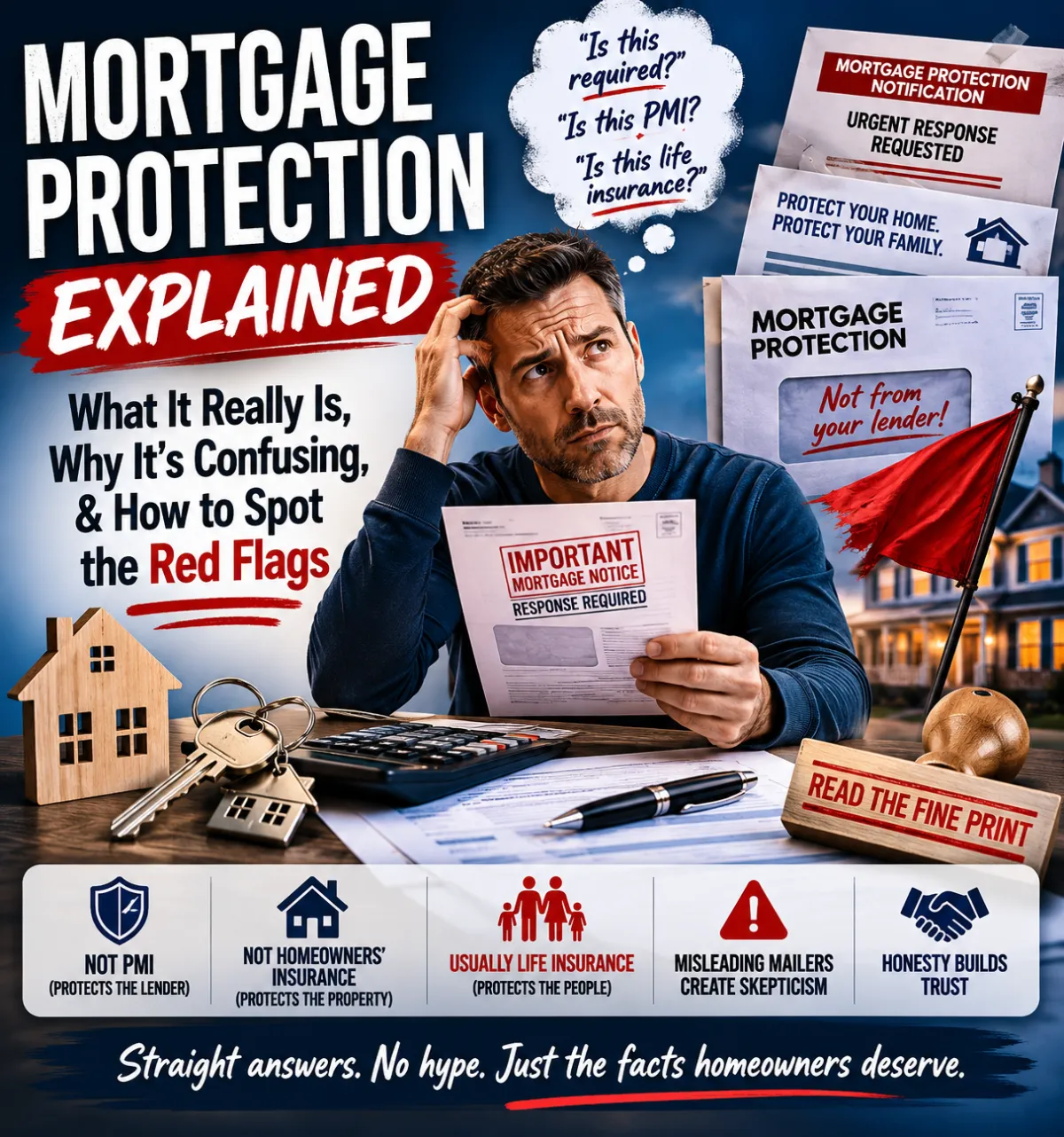
Mortgage Protection Isn't the Problem
Let's skip the sugar coating. 🤯
A friend of mine, a realtor, brought up mortgage protection recently. Not as a sales pitch. Just a real conversation about what homeowners actually hear when that phrase comes up, and why so many people already have their guard up before the conversation even starts.
And honestly? I get it. 🤷♂️
The phrase "mortgage protection" sounds simple. The way it gets used in the real world is anything but. Some homeowners think it means private mortgage insurance (PMI). Some think it means homeowners' insurance. Some assume the bank requires it. And a whole lot of people only know the term because an official-looking letter showed up in their mailbox right after closing.
That is where the mistrust starts. 😒
To be clear, this is not an attack on agents doing this work the right way. Many licensed professionals are genuinely trying to help families solve a real problem. The issue is not the person who explains it clearly. The issue is the marketing that made people skeptical before the real conversation ever got off the ground.
The Name Creates Confusion
Private mortgage insurance protects the lender. Homeowners' insurance protects the property. Life insurance protects the people who may be left behind.
Those are not the same thing. Not even close. 🔄
The Consumer Financial Protection Bureau says it plainly: PMI "protects the lender, not you" if payments stop. The Texas Department of Insurance agrees.¹ ² A homeowner can pay PMI every month and still have zero protection for their family if they die. PMI does not replace income. It does not pay the surviving spouse. It does not help the kids stay in the house.
PMI protects the lender from borrower default. Full stop.
Mortgage Protection Is Usually Just Life Insurance
Here is where people overcomplicate it. 😤
In most cases, mortgage protection is not some mysterious financial product. It is life insurance discussed through the lens of a mortgage. The mortgage is the reason for the conversation, but the actual policy is usually life insurance.
The NAIC explains that life insurance pays a death benefit if the insured dies while the policy is in effect, and that the benefit can cover lost income, funeral expenses, debt, medical costs, and childcare.³ That is the real conversation.
The mortgage may be the biggest bill, but it is rarely the only one. That is why I do not like reducing this whole discussion to "let's just pay off the house." Paying off the house might be the right move. But the better question is bigger than that.
If your income stopped permanently tomorrow, what would your family need to stay in the home and keep life stable?🤔
That is not fear-based. That is practical.
So, Why Does Health Come Into It?
This throws a lot of homeowners off. 🤯
If the product is life insurance, the insurance company evaluates the insured person, not the property. A healthy 35-year-old and a 62-year-old with heart issues might both owe $300,000 on a mortgage. Same balance. Very different risk.
That is why applications may ask about health history, prescriptions, diagnoses, hospitalizations, and more. It does not mean the process is harder than it should be. It means the coverage is life insurance, and life insurance is priced around the person.
"No exam" or simplified issue coverage is often advertised as an easier path, and sometimes it is the right one. But the NAIC is clear: policies with less health information usually cost more and provide less coverage.⁴ Higher premiums, lower limits, graded benefits, and waiting periods are all possible trade-offs. The homeowner deserves to understand what they are agreeing to before signing anything. ✔️
The Mailers Are a Big Part of the Problem
Some mortgage protection marketing is professional and honest. Some of it is not. 🛑
The questionable mailers are the ones that look official, sound urgent, and make homeowners feel like the notice is tied to their lender. They reference public mortgage records. They blur the line between an insurance offer and an actual mortgage notice. They create an impression that the bank personally reached out.
Once someone feels misled, the real planning conversation becomes 10 times harder. 😒
The FTC and the CFPB have both warned companies about misleading mortgage advertising.⁵ ⁶ These warnings are not about every agent in the space. They are about tactics that erode trust.
If it is life insurance, say so. If it's not required by the lender, say that. If the homeowner's info came from public records, do not dress it up like the bank sent the letter.
That is not complicated. That is just honesty.
Not Every "Mortgage Protection" Policy Works the Same Way
The label "mortgage protection" does not describe one product. ⚠️
It might be level term life insurance, where the death benefit stays the same for 10, 20, or 30 years. It might be a decreasing term, where the benefit drops over time alongside the mortgage balance. It might be a simplified issue, with fewer health requirements but higher premiums or lower coverage. It might be permanent life insurance.
The label is not the contract. The contract is what matters.
Before buying anything, a homeowner should know: What type of policy is this? Does the death benefit stay level? Who receives the money? What are the health requirements? What happens if the house is sold or refinanced?
The Money Does Not Have to Go to the Bank
Here is something many people do not realize. 💡
Most life insurance policies pay the beneficiary chosen by the policy owner, not the lender.⁸ The surviving spouse may pay off the mortgage. Or they may keep making monthly payments and use the benefit to replace income. They may need breathing room for funeral costs, medical bills, property taxes, or just getting through the next few months.
When someone dies, the family does not just inherit a mortgage balance. They inherit decisions, fast ones, emotional ones, and financial ones. A properly structured life insurance policy creates options for all of that.
A better, more honest explanation than "this pays off your mortgage" is this: a life insurance policy can give your family money and options if your income is gone.
So, is Mortgage Protection a Scam?
No.
But some of the tactics used to market it have created enough confusion that homeowners are right to ask hard questions. 🤔
At its best, mortgage protection is a simple planning conversation. You own a home. Someone depends on your income. If you die, the mortgage and the bills do not disappear. Life insurance may help your family keep the home and keep options on the table.
That is not a scam. That is planning. ✔️
Questions Every Homeowner Should Ask Before Buying
🛑 Slow the conversation down. Ask directly:
What type of policy is this? Term? Whole life? Decreasing term?
Does the death benefit stay level or go down over time?
Who receives the money if I die?
Is this required by my lender?
What health questions are required? Is there a medical exam?
What happens if I'm declined?
What happens if I refinance or sell the house?
Can my beneficiary use the money for expenses other than the mortgage?
Are there waiting periods, graded benefits, or contestability rules?
Those questions are not rude. They are responsible. 💪 A professional should be able to answer every single one clearly. If the answers are vague, rushed, or pressured, slow down before making any decision.
Bottom Line
Mortgage protection has a reputation problem because misleading marketing created distrust around a legitimate need. If someone owns a home and people depend on their income, there should be a plan for what happens if that income disappears.
If you died, could your family keep the home without panic?🤔
That is the heart of this conversation.
Family protection.
That is what mortgage protection should have meant all along.
📞Connect With
Guy Bester
Financial Professional
Phone: (512) 710-9680
May serbisyo kami sa wikang Tagalog
Notes
Consumer Financial Protection Bureau, “What is private mortgage insurance?” December 21, 2023. The CFPB explains that private mortgage insurance protects the lender, not the borrower, if payments stop.
Texas Department of Insurance, “What is private mortgage insurance? Learn why you might need it,” April 10, 2025. The department says private mortgage insurance protects the lender, not the homeowner, if mortgage payments stop.
National Association of Insurance Commissioners, Life Insurance Buyer’s Guide. The guide explains that life insurance pays a death benefit while the policy is in effect and can help protect against financial hardships after death, such as lost income, funeral expenses, debt repayment, medical or nursing care expenses, and child care costs.
National Association of Insurance Commissioners, Life Insurance Buyer’s Guide. The guide explains that insurers may ask health questions, require a doctor visit, or assess health, and that policies with less detailed health information usually cost more and provide less coverage.
Federal Trade Commission, “FTC Warns Mortgage Advertisers that Their Ads May Violate Federal Law,” November 19, 2012. The FTC says the mortgage advertising rule prohibits material misrepresentations in advertising or other commercial communications about consumer mortgages.
Consumer Financial Protection Bureau, “Consumer Financial Protection Bureau Warns Companies Against Misleading Consumers With False Mortgage Advertisements,” November 19, 2012. The CFPB warned companies against misleading consumers with false mortgage advertisements.
Fannie Mae, “What to Know About Private Mortgage Insurance.” Fannie Mae explains that private mortgage insurance is not homeowners' insurance and protects only the lender.
National Association of Insurance Commissioners, “Life Insurance.” The NAIC explains that term life insurance pays money to named beneficiaries if the insured dies during the term.