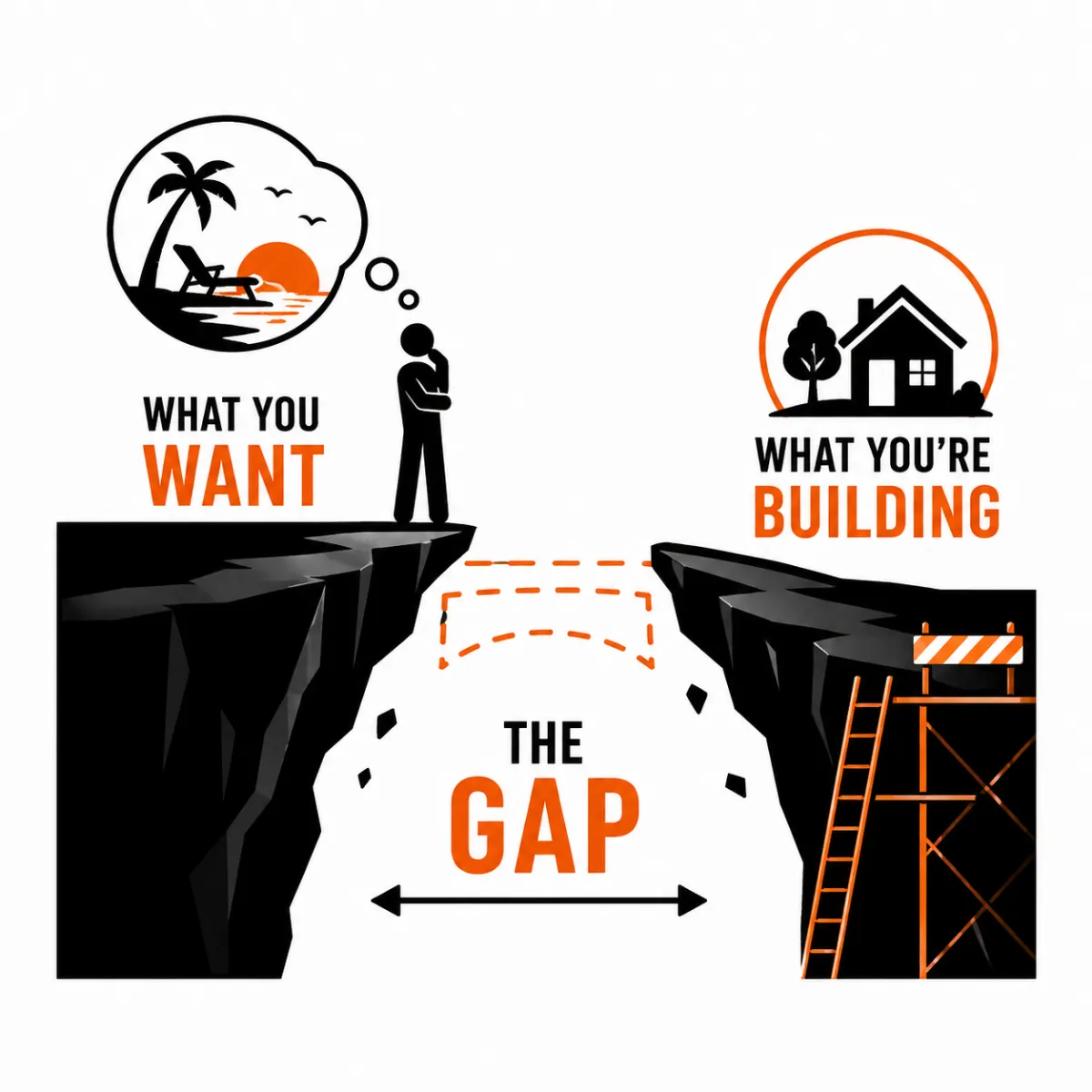
The Gap Between What You Want and What You’re Building
Let’s Skip The Sugar Coating. 🤯
Most people want a good retirement. ✔️ They want stability, flexibility, and enough income to live the way they have pictured for years. 🏡💰 Ask almost anyone what that looks like, and they can describe it without hesitation. The problem is not the vision; it is that people often fail to connect that vision to the work required to achieve it. 😒
You can see it in simple ways. Someone wants a comfortable retirement, but they save inconsistently. 💸 They prioritize spending today over planning for tomorrow and assume things will work out or that they will have time to fix it later. That does not make them careless. It makes them human. 🤷♂️ But it does create a gap between what they want and what their current habits are building over time.
This is not just about saving more money. You need to understand that time matters, and when you delay decisions, you limit your options later. According to the Federal Reserve, many Americans approaching retirement have less saved than they expected, with a significant portion reporting little to no savings for retirement.¹ This reality usually does not come from one bad decision. It comes from years of competing priorities where long-term planning never fully took hold.
At some point, you shift the conversation 🔄 from what you should have done earlier to what you can still do now. That shift matters because time changes how your plan needs to function. When you have fewer working years ahead, you can no longer focus only on growth. You have to focus on how you position your assets to support income, handle rising costs, and maintain stability in an unpredictable environment.
This is where many plans begin to show their limitations. ⚠️ Having money is not the same as having a plan for how that money will behave. Assets that once focused on long-term growth often have to provide income, withstand market volatility, and cover unexpected expenses simultaneously. That expectation does not always hold up, especially during market stress or over longer retirement timelines.²
Economist William Sharpe addressed this challenge directly when he said, “The hardest problem in finance is how to turn a pool of assets into a steady stream of income.”³ That problem becomes more relevant as you move closer to retirement and transition from accumulation to distribution. At that point, the focus shifts from how much you saved to how you structure those savings to function over time. Let’s be honest, people are living longer than previous generations, which puts more pressure on savings, income strategies, and healthcare planning. According to the Social Security Administration, a significant percentage of retirees will live well into their 80s, and many couples will see at least one spouse live into their 90s.⁴ That extended timeline makes income structure and protection more important. 🔐
This does not mean the situation is hopeless. It means you need a more intentional approach. The lifestyle someone wants in retirement does not happen by default. You build it by structuring income, managing risk, and making tradeoffs along the way. As behavioral economist Richard Thaler has noted, people often make short-term decisions that conflict with long-term goals, not because they lack awareness, but because immediate priorities take precedence.⁵
You cannot go back and start earlier, but you can take a clear look at where you stand today and decide how to move forward. That may mean reevaluating how you position your assets, generate income, and account for future risks. The question is not whether you put the ideal plan in place years ago. The question is whether your current plan can support the outcome you still want. 🤔
As you were reading through this, what actually stood out to you? If any part of it got you thinking about your own situation, it might be worth taking a closer look at what you already have or what might be missing.
Let's walk through it together. We can keep it simple and just see what makes sense for you.
📞Connect With
Guy Bester
Financial Professional
Phone: (512) 710-9680
May serbisyo kami sa wikang Tagalog
Footnotes
Board of Governors of the Federal Reserve System, Report on the Economic Well-Being of U.S. Households in 2023 (Washington, DC: Federal Reserve, 2024), https://www.federalreserve.gov/consumerscommunities/shed.htm.
J.P. Morgan Asset Management, Guide to Retirement 2024 (New York: J.P. Morgan Asset Management, 2024), https://am.jpmorgan.com/us/en/asset-management/adv/insights/retirement-insights/guide-to-retirement/.
William F. Sharpe, “Retirement Income Scenarios,” Stanford University, 2017, https://web.stanford.edu/~wfsharpe/.
Social Security Administration, Actuarial Life Table (Washington, DC: SSA, 2023), https://www.ssa.gov/oact/STATS/table4c6.html.
Richard H. Thaler, Misbehaving: The Making of Behavioral Economics (New York: W.W. Norton & Company, 2015).